A 12V compressor fridge that keeps switching off is one of the most common camping power complaints. The fridge is usually protecting itself or your battery. The trick is working out what it's reacting to.
1. How the fridge decides to cut out
Most 12V compressor fridges have battery protection: a low-voltage cut-out that switches the compressor off when the voltage at the fridge drops below a set level, then restarts once it recovers. It's there to stop the fridge flattening your vehicle's starting battery.
The key words are at the fridge. The fridge doesn't see your battery's voltage. It sees the battery voltage minus whatever is lost along the lead, plugs and connections, and that loss is biggest at the moment the compressor starts.
1a. Why the start matters
A compressor draws more current for a moment as it starts than it does once it's running. More current means more voltage lost along the lead and connections, so the voltage at the fridge dips hardest right then.
That's why the classic pattern is a fridge that clicks on, then straight off again, over and over. The battery looks fine on the monitor, but each start dips the voltage at the fridge below its cut-out level. Once the compressor stops, the voltage bounces back, and the fridge tries again.
2. Check these in order
1. Battery protection setting. Many fridges let you choose the cut-out level (often labelled high, medium and low). High suits a fridge running off a starting battery. When it runs off a separate lithium or deep-cycle battery, the maker's manual may recommend a lower setting. Check the manual for what each setting means and which suits your battery. A setting that's too high for your setup is a very common cause.
2. Is the battery actually low? Check your battery monitor or the battery's app. If the battery is genuinely low, the fridge is doing its job. The problem is your power budget, not the fridge. See How to Calculate Your 12V Power Needs, and How to Read a 12V Battery Monitor to make sure the reading is right.
3. Plugs and sockets. Cigarette-lighter style plugs and sockets are a well-known weak point. They work loose on corrugations, the contacts tarnish, and a poor contact can drop enough voltage to trip the fridge. Look for a plug that wobbles, feels warm, or shows discolouration or melting. If a plug or socket shows heat damage, stop using it and have it replaced by an auto electrician.
4. Heat and ventilation. In hot weather the compressor runs longer and works harder. Fridges need airflow around their vents. Packed in tight with bags against the vents, or in a closed, hot vehicle, it runs longer and draws more, and some fridges show a fault for overheating.
5. Error codes and lights. Most fridges flash a code or show an error when they cut out. Look it up in the manual. It often tells you straight away whether it's low voltage, overheating, a fan fault or something else.
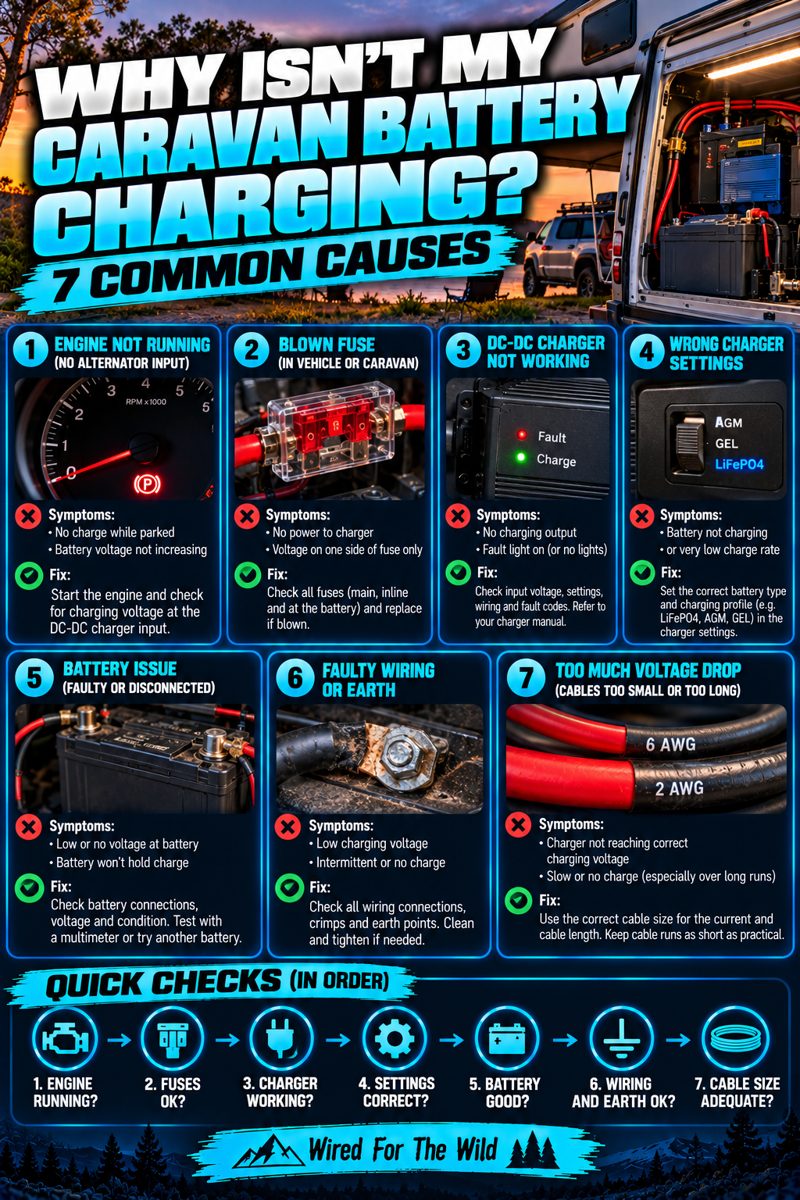
6. Charging that isn't keeping up. If the battery runs down a bit more each day, the fridge will eventually trip. See Why Isn't My Caravan Battery Charging?.
3. A simple voltage check (diagnosis only)
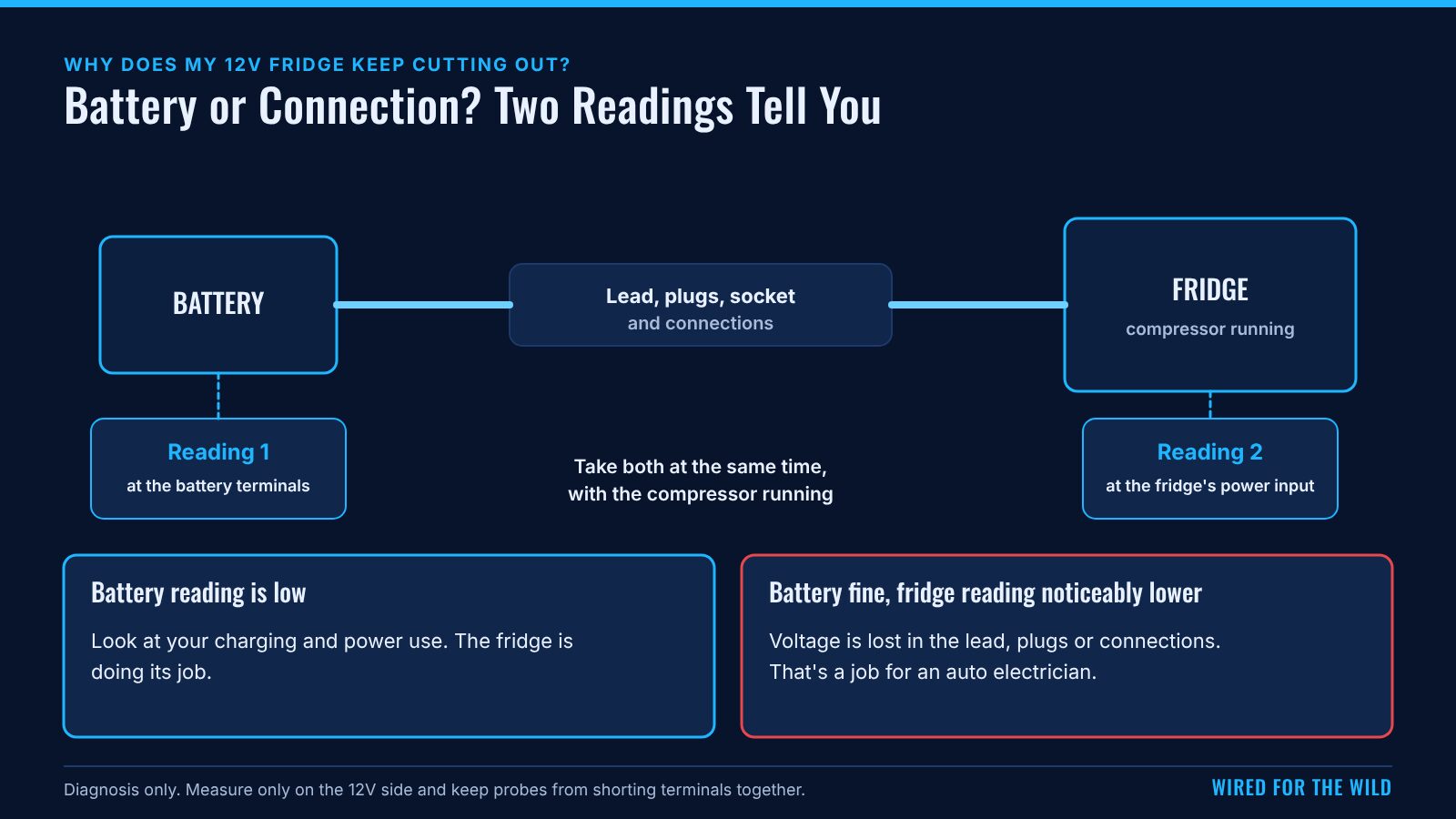
If you have a multimeter, two readings can show whether the problem is the battery or the connection between the battery and the fridge.
- At the battery terminals, with the fridge running.
- At the fridge's power input, at the same time, with the compressor running.
If the reading at the fridge is noticeably lower than at the battery, voltage is being lost along the way, in the lead, plugs, socket or connections. Revival Academy 101 explains this kind of test in Find a 12V Fault Step by Step.
What to do with the result: if the battery reading is low, look at your charging and power use. If the battery is fine but the fridge reading is low, the fix is in the wiring, the plugs or the connections. That's a job for an auto electrician, who can check the circuit and make it suit your fridge's current draw. Don't just swap in a different lead or fuse and hope.
Measure only on the 12V side. Keep probes away from shorting terminals together.
3a. How much voltage can a lead lose? A worked example
This uses the method from our 12V Cable and Fuse Size Guide. It shows why a long, thin run can trip a fridge. It doesn't tell you what cable to fit.
Say a fridge draws 5A while running (an example figure; check your fridge's manual). It sits 5 metres from the battery, so the current travels a 10-metre round trip.
| Copper area | Resistance (0.0172 × 10 ÷ area) | Voltage lost at 5A | Share of 12V |
|---|---|---|---|
| 2.5 mm² | about 0.069 ohms | about 0.34V | about 2.9% |
| 4 mm² | about 0.043 ohms | about 0.22V | about 1.8% |
| 6 mm² | about 0.029 ohms | about 0.14V | about 1.2% |
Those figures are for the cable alone, with copper at room temperature, while the compressor is running. The start-up current is higher, so the dip at the start is bigger. Every plug, socket and joint adds more loss on top.
Add those up, and a battery that reads fine can still leave the fridge below its cut-out level for that moment. Try your own run in the 12V Voltage Drop Calculator.
Remember that auto cable sold as "6mm" or "8 B&S" is an overall size, not the copper area. The cable and fuse guide explains how to check. If your fridge's manual names a cable size for the run length, use that. Any change to the wiring is a job for an auto electrician.
4. Quick fixes you can do safely
- Check and adjust the battery protection setting as the manual describes.
- Push plugs firmly home, and use a fridge with a more secure connector if your fridge and system support one.
- Give the fridge room to breathe, and keep it out of direct sun.
- Pre-cool the fridge and food at home on mains power before the trip.
- Keep the lid shut and pack it so cold air isn't lost every time you open it.
5. When to stop and get help
- Any plug, socket or lead that's warm, discoloured or melted.
- The voltage check shows a big loss between the battery and the fridge.
- The fridge cuts out with a full battery and a good connection.
- An error code that the manual says needs service.
These are diagnosis steps only, not a wiring guide. Your fridge's manual and an auto electrician are the right sources for any change to the wiring, fuses or connectors.
5a. What you see, and what it usually means
| What you see | Usual suspect | Check first |
|---|---|---|
| Clicks on, then off again straight away, with a good battery | Voltage dip at start: lead, plugs or setting | Protection setting, then the two-point voltage check |
| Cuts out overnight, and the battery reads low in the morning | Not enough battery or charging | Power budget and charging |
| Cuts out only on hot afternoons | Heat, ventilation, longer running | Airflow around the vents, shade |
| Cuts out on rough roads | Loose plug or socket | Plug fit, socket condition |
| Warm or discoloured plug | Poor contact heating up | Stop using it. Auto electrician |
| An error code shows | Whatever the code says | The manual's code list |
6. Cut-out log (fill in)
Write down each cut-out for a few days. A pattern points to the cause faster than guessing.
| Date and time | Battery reading | Reading at fridge (if checked) | Weather or heat | What the fridge showed | Notes |
|---|---|---|---|---|---|
7. Frequently asked questions
Can I just set the protection to low?
Only if your manual says that setting suits how your fridge is powered. A low setting is usually meant for a separate house battery, not the vehicle's starting battery. Setting it lower to hide a wiring problem just moves the problem.
Will a bigger battery fix it?
Not if the cause is voltage lost along the lead. A bigger battery helps when the battery is actually running low. Do the two-point voltage check first.
Why does it work at home but not in the car?
At home it often runs on mains power, or on a short lead. In the vehicle it may be on a long run with several plugs and joints, and in a hotter space.
Is it the fridge?
Sometimes, but check the setting, the battery and the connections first. An error code that the manual says needs service is the time to contact the maker.
8. Quick summary
- The fridge reacts to the voltage at the fridge, not at the battery.
- Check the protection setting, the battery, the plugs, the heat and the error codes, in that order.
- The two-point voltage check shows whether it's the battery or the connection.
- Long, thin runs and tired plugs lose voltage, worst at compressor start.
- Any wiring change, warm plug or melted socket is a job for an auto electrician.
Safety: for high-current DC gear and any change to 12V wiring, follow the maker's installation manual and have an auto electrician do or check the work. Work on 240V AC wiring must be done by a licensed electrician.