Before you buy a battery, a solar panel or a DC-DC charger, you need one number: how much power you use in a day at camp. Get that roughly right and every other choice gets easier. Skip it and you'll either run flat on the second night or carry gear you didn't need.
1. Watts, hours and watt-hours
- Watts (W) is how hard something draws power while it's running. It's on the label or in the manual.
- Hours (h) is how long it runs each day.
- Watt-hours (Wh) is the energy it uses: watts × hours.
A 10W light on for 4 hours uses 10 × 4 = 40Wh.
Some gear lists amps (A) instead of watts. On a 12V system, watts ≈ amps × 12. A light drawing about 0.8A uses about 10W.
2. List everything you run
Write down every item that runs off your 12V battery on a normal day at camp, with its watts and hours. Don't forget the small stuff:
- fridge (usually the biggest load)
- lights inside and out
- water pump
- fans
- phone, camera, drone and tablet charging
- laptop
- radio, UHF or satellite gear
- anything running through an inverter
If you don't know a figure, write "unknown" and find it in the manual, or measure it with a battery monitor. Guessing low is how people run flat.
3. Fridges are different
A compressor fridge doesn't run all the time. It cycles on and off. Its daily use depends on how long the compressor runs, which goes up in hot weather, with warm food going in, and when the lid's opened often.
- Watts × run time: a 40W fridge running 30% of the time uses about 40 × 24 × 0.3 = 288Wh a day.
- Or use the maker's daily figure, and check the temperatures it was tested at. Expect more in hot weather.
The 12V Fridge Power Draw Calculator does this for you.
3a. Hot weather and the fridge
The fridge's run time climbs in hot weather.
Example figures: the same 40W fridge running 40% of the time instead of 30% uses 40 × 24 × 0.4 = 384Wh, which is 96Wh more a day. That's more than all the lights, fan and pump together in the weekend example. Plan with summer figures if you travel in summer.
To keep it down, park the fridge in shade, give it airflow around the vents, pre-cool food and drinks at home, and keep lid openings short.
4. Gear that runs through an inverter
Anything that plugs into 240V AC runs through an inverter, and inverters lose some energy turning 12V into 240V AC. Divide the item's energy by the inverter's efficiency.
Example: a laptop using 60Wh at the plug, through an 85% efficient inverter: 60 ÷ 0.85 ≈ 71Wh from the battery.
Use 12V or USB chargers instead of the inverter where you can, and switch the inverter off when you're not using it, because it uses power just being on.
5. Add it up, then add a margin
Add every item's watt-hours. Then add a margin, about 20%, to cover estimates, cable losses, warm weather and the things you forgot.
To turn watt-hours into amp-hours on a 12V system, divide by the battery voltage. A "12V" lithium (LiFePO4) battery is about 12.8V nominal.
6. Worked example: a weekend for two
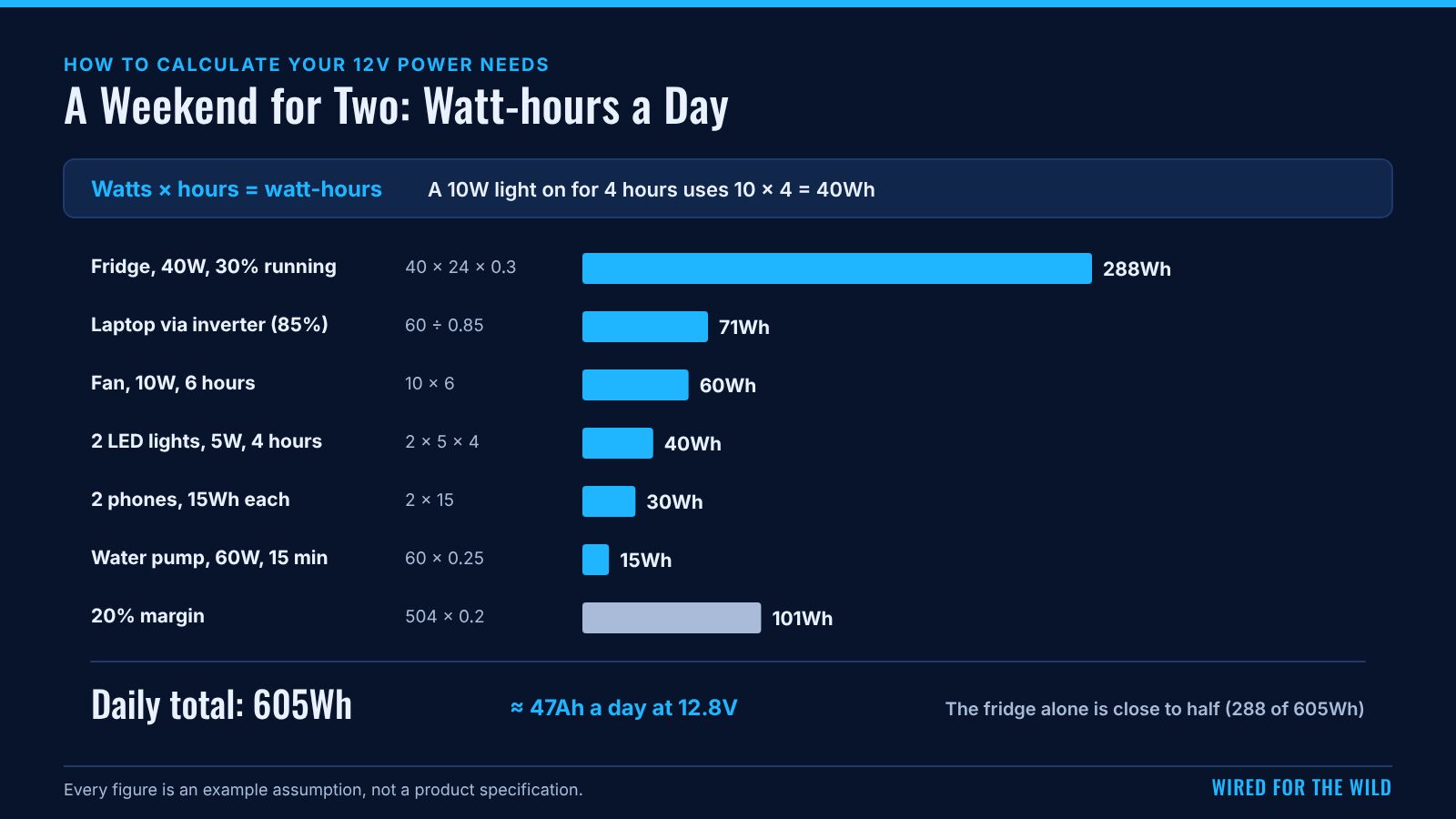
Every figure is an example assumption, not a product specification.
| Item | Working | Wh/day |
|---|---|---|
| Fridge, 40W, compressor running 30% of the time | 40 × 24 × 0.3 | 288 |
| 2 LED lights, 5W each, 4 hours | 2 × 5 × 4 | 40 |
| Fan, 10W, 6 hours | 10 × 6 | 60 |
| Water pump, 60W, 15 minutes | 60 × 0.25 | 15 |
| 2 phones, 15Wh each | 2 × 15 | 30 |
| Laptop, 60Wh at the plug, 85% inverter | 60 ÷ 0.85 | 71 |
| Subtotal | 504 | |
| 20% margin | 504 × 0.2 | 101 |
| Daily total | 605Wh |
In amp-hours at 12.8V: 605 ÷ 12.8 ≈ 47Ah a day.
The fridge is close to half the total on its own (288 of 605Wh), which is typical.
6a. Worked example 2: a week touring in summer
Every figure is an example assumption. Two people, hotter weather, longer evenings:
| Item | Working | Wh/day |
|---|---|---|
| Fridge, 40W, running 40% (hot weather) | 40 × 24 × 0.4 | 384 |
| 2 LED lights, 5W each, 5 hours | 2 × 5 × 5 | 50 |
| Fan, 10W, 10 hours | 10 × 10 | 100 |
| Water pump, 60W, 30 minutes | 60 × 0.5 | 30 |
| Phones and a camera | example | 45 |
| Laptop, 60Wh at the plug, 85% inverter | 60 ÷ 0.85 | 71 |
| Subtotal | 680 | |
| 20% margin | 680 × 0.2 | 136 |
| Daily total | 816Wh (≈ 64Ah at 12.8V) |
The same 12.8V 100Ah lithium battery (1,024Wh usable at 80%) now lasts about 1,024 ÷ 816 ≈ 1.3 days with no charging. For a week, daily charging from solar or driving has to keep up. See Solar & Charging Check.
6b. Measure instead of guessing
A battery monitor with a shunt shows how many amp-hours you really use.
Example: the monitor shows 44Ah used from one evening to the next. At 12.8V that's 44 × 12.8 ≈ 563Wh a day. That's your real number, including the fridge on that day's weather. See Battery Management for how monitors work.
Measure for a few days in conditions like your trip, then use that figure instead of your estimate.
7. How long will my battery last?
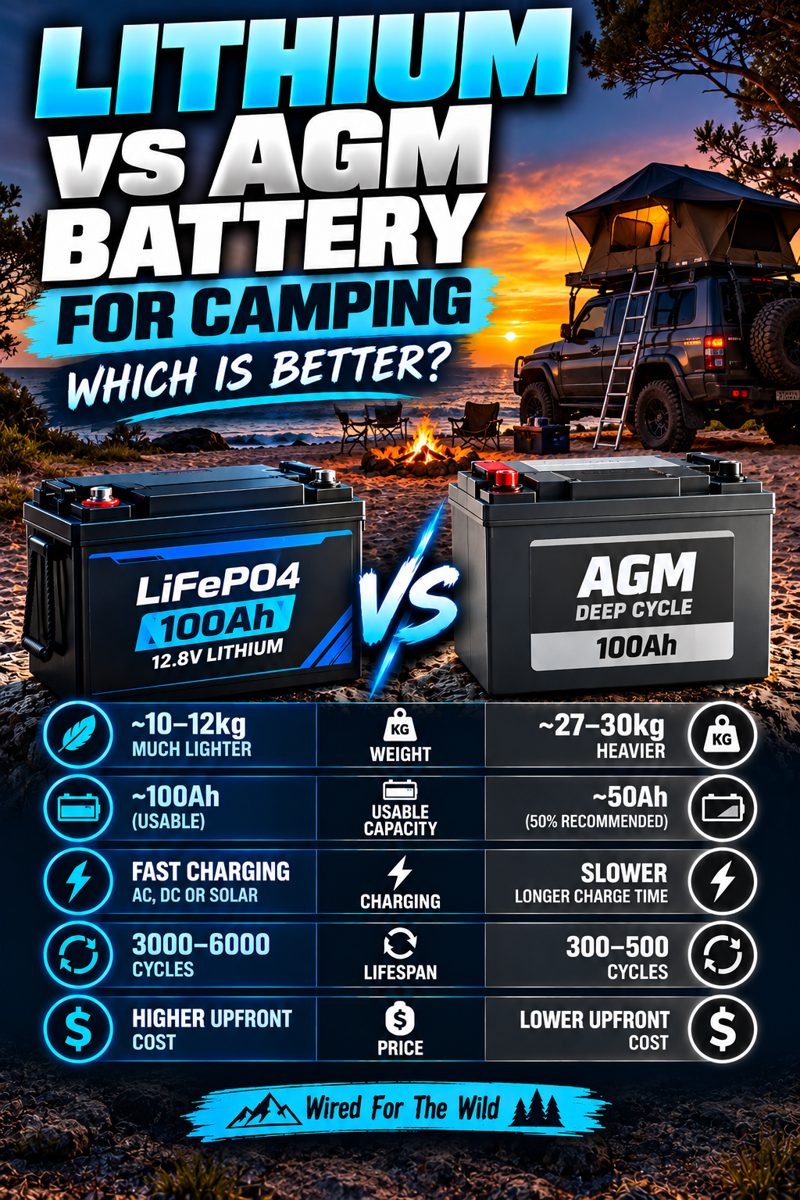
Not all of a battery's rating is usable. Use your battery maker's figure. As a rough guide, lithium (LiFePO4) batteries usually let you use most of their rating, and AGM batteries last much longer if you only use about half. See Lithium vs AGM Battery for Camping.
Example: a 12.8V 100Ah lithium battery at 80% usable (example figure):
- 12.8 × 100 × 0.8 = 1,024Wh usable
- 1,024 ÷ 605 ≈ 1.7 days with no charging at all
The same daily use on a 100Ah AGM at 50% usable: 12 × 100 × 0.5 = 600Wh, just under 1 day.
Most people don't plan to run the battery to its limit. Keeping some in reserve for a cloudy morning is sensible.
8. What next
- Size the battery with the Daily Energy Use & Battery Size Calculator.
- Check your charging with the Solar & Charging Check and the DC-DC Charger Size Calculator.
- Plan the whole trip with the Camping Trip Power Budget Calculator.
- Checking gear you already have? Try Check My System.
9. My daily power (fill in)
| Item | Watts | Hours a day (or Wh from the maker) | Through inverter? (÷ 0.85) | Wh/day |
|---|---|---|---|---|
| Fridge | ||||
| Lights | ||||
| Fan | ||||
| Water pump | ||||
| Phones, cameras, tablets | ||||
| Laptop | ||||
| Other | ||||
| Subtotal | ||||
| + 20% margin | ||||
| Daily total (Wh) | ||||
| ÷ 12.8 = Ah a day |
10. Common mistakes
- Using the fridge's watts × 24 hours. Compressor fridges cycle.
- Planning with cool-weather fridge figures for a summer trip.
- Forgetting inverter losses and standby.
- Leaving out the small loads.
- Counting the battery's full rating as usable.
- Never checking real use with a monitor.
11. Frequently asked questions
How many amp-hours do I need a day for camping?
It depends entirely on your gear and the weather. The weekend example uses about 47Ah a day and the summer touring example about 64Ah. Add up your own list.
How much power does a 12V fridge use per day?
It depends on its draw, its run time and the weather. The examples use 288Wh and 384Wh. The 12V Fridge Power Draw Calculator works out yours.
Should I use the inverter to charge things?
Use 12V or USB chargers where you can. They avoid the inverter's losses and standby draw.
Why add a 20% margin?
It covers estimates that run low, cable and charging losses, hot days and the things you forgot.
Is a 100Ah lithium battery enough?
For the weekend example, it covers about 1.7 days without charging. With daily charging from solar or driving, it may be plenty. Check with the Daily Energy Use & Battery Size Calculator.
These are planning estimates only, not a system design, wiring specification or safety assessment. Your real use changes with the weather, the gear and how you camp.
Safety: work on 240V AC wiring, including inverter outputs and mains inlets, must be done by a licensed electrician. For high-current DC gear such as inverters, DC-DC chargers and battery links, follow the maker's installation manual and have an auto electrician check your work if you're unsure.