The quick answer
A generator doesn't charge your battery on its own. It supplies 240V power to a battery charger, and the charger does the charging. The charger needs to suit your battery type, and the generator needs to be big enough for the charger plus anything else you run at the same time.
Set up right, a generator is a handy back-up for cloudy days, winter trips and long stays away from a powered site. Run it outdoors, well away from your van, tent and any open windows, and follow the instructions for your generator, charger and battery.
Safety first: generators produce carbon monoxide, which you can't see or smell. Never run one inside a caravan, tent, annexe, garage or any enclosed or partly enclosed space, even with the doors or windows open.
When generator charging makes sense
Solar works well when the sun is out, but it drops off on cloudy days and in winter, and mains power is only there at a powered site or at home. A generator fills the gap when those can't keep up.
- You're staying put for a few days and not driving, so your DC-DC charger isn't topping the battery up.
- The weather has turned and your solar isn't putting back what you use.
- You want a back-up on longer trips, alongside solar and charging while driving.
It's less useful on short trips where driving or solar already covers your use. Some campgrounds limit when, or whether, generators can be used, so always check the rules where you're staying. At a powered site, see Grid Supply for charging from mains power instead.
How it works: generator, charger, battery
- The generator makes 240V AC power.
- A 240V battery charger plugs into the generator, turns that power into 12V DC and controls the charge. It works through the charging stages, uses the right voltages for your battery type and limits the current.
- The battery receives a controlled charge.
Charger makers treat a generator as a normal power source. Victron's Blue Smart IP22 charger manual, for example, lists the AC supply as mains, a generator or an inverter. If your caravan has an inverter/charger, its built-in charger does the same job from 240V.
The important part is that the charger is in control. Never connect a generator to a battery without a suitable charger in between.
Never back-feed: don't plug a generator into a power point or connect it to a switchboard to power a building or installation. A generator inlet or changeover switch must be installed by a licensed electrician, and so must any work on 240V wiring in a caravan, including mains inlets.
What about the 12V outlet on a generator?
Many generators have a small 12V DC outlet, but it isn't a substitute for a proper battery charger.
- These outlets are low-current. Honda Australia lists the EU22's DC output at 8.3A, and Yamaha Motor Australia lists the EF2200iS at 12V / 3A.
- Honda's EU2200i owner's manual says its DC charging output is not regulated and doesn't decrease as the battery reaches full charge, so you have to keep checking the battery voltage to avoid overcharging.
- They don't offer a lithium (LiFePO4) charge profile.
For a camping battery, and especially a lithium one, run a proper 240V battery charger from the generator's AC outlet.
Choosing a battery charger
- The right charge profile: lithium (LiFePO4) batteries need a charger with a lithium setting, using the voltages your battery maker recommends. AGM batteries need an AGM setting.
- The right battery type set: a charger set to the wrong type is one of the most common reasons a battery doesn't charge properly.
- A suitable charge current: big enough to refill the battery in the time you'll run the generator, but within your battery's maximum charge current.
- Smart, multi-stage charging that controls the charge from start to finish.
Our Charger & Inverter Sizing Calculator works out the charging current you need. Choose Mains battery charger (plug-in) as the charger type. Already have a charger fitted? Check My System shows which settings to confirm.
How big a generator do you need?
There's no single answer, because it depends on your charger and what else you run. Here's a simple way to work it out.
1. Work out what the charger draws from the 240V side. A charger draws more from the generator than it delivers to the battery. Some energy is lost as heat (efficiency), and the generator has to supply a bit extra because of the charger's power factor. Victron's Blue Smart IP22 chargers, for example, are rated up to 93 to 94% efficient with a power factor above 0.6.
Example only, for one 12V 30A charger:
- Power to the battery: 30A × 14.2V ≈ 430W
- Allowing for 93% efficiency: 430W ÷ 0.93 ≈ 460W
- Allowing for a power factor of 0.6: 460W ÷ 0.6 ≈ 770VA of generator capacity
Use the figures for your own charger from its label or manual. This worked example is for one charger, not a rule for all of them.
2. Add anything else running at the same time. Kettles, microwaves and fridges all add load, and motors and compressors can draw several times their running watts as they start. List your 240V appliances in the calculator's appliance section. It's built for sizing an inverter, but the same list shows what your generator has to supply.
3. Leave headroom. Don't plan to run a generator flat out. For its inverter/chargers, Victron advises choosing an inverter generator at least 30% larger than a comparable conventional generator, because inverter generators are electronically limited and easier to overload with surges. Check your charger and generator manuals for their own guidance.
Eco mode: many generators have an economy setting that lowers engine speed when the load is light. If your charger or appliances struggle, check what your generator manual says about eco mode.
How long will charging take?
As a rough guide, divide the amp hours you need to put back by the charger's output. If you've used 60Ah, a 20A charger needs about 3 hours and a 30A charger about 2 hours. Real times are a bit longer because charging tapers off as the battery gets close to full.
- Charger size: a bigger charger is faster, up to your battery's limit.
- Your battery's charge limit: the battery maker sets a maximum charge current, and some recommend a lower rate for everyday charging.
- Battery temperature: lithium batteries may limit or stop charging when cold.
- Cable and connections: thin or long cable and poor connections stop the charger reaching full voltage. See our 12V Cable and Fuse Size Guide.
Not sure how much you use each day? Our Battery Size Calculator works it out.
Battery type and charge profile
Lithium (LiFePO4):
- Use a charger with a lithium profile set to your battery maker's charge voltages. Lead-acid settings aren't suitable.
- Stay within the battery's maximum charge current. Victron's Lithium NG battery, for example, allows up to 1C but recommends 0.5C for routine charging.
- Don't charge below the battery's minimum charging temperature. Victron's charger manual says not to charge lithium below 0°C, while its Lithium NG battery sets +5°C. REDARC explains that charging when too cold can cause lithium plating, which permanently reduces capacity. Check your own battery's manual for its limit.
Some batteries have low-temperature protection or self-heating. See Battery Management.
AGM: use the charger's AGM setting and follow the battery maker's instructions.
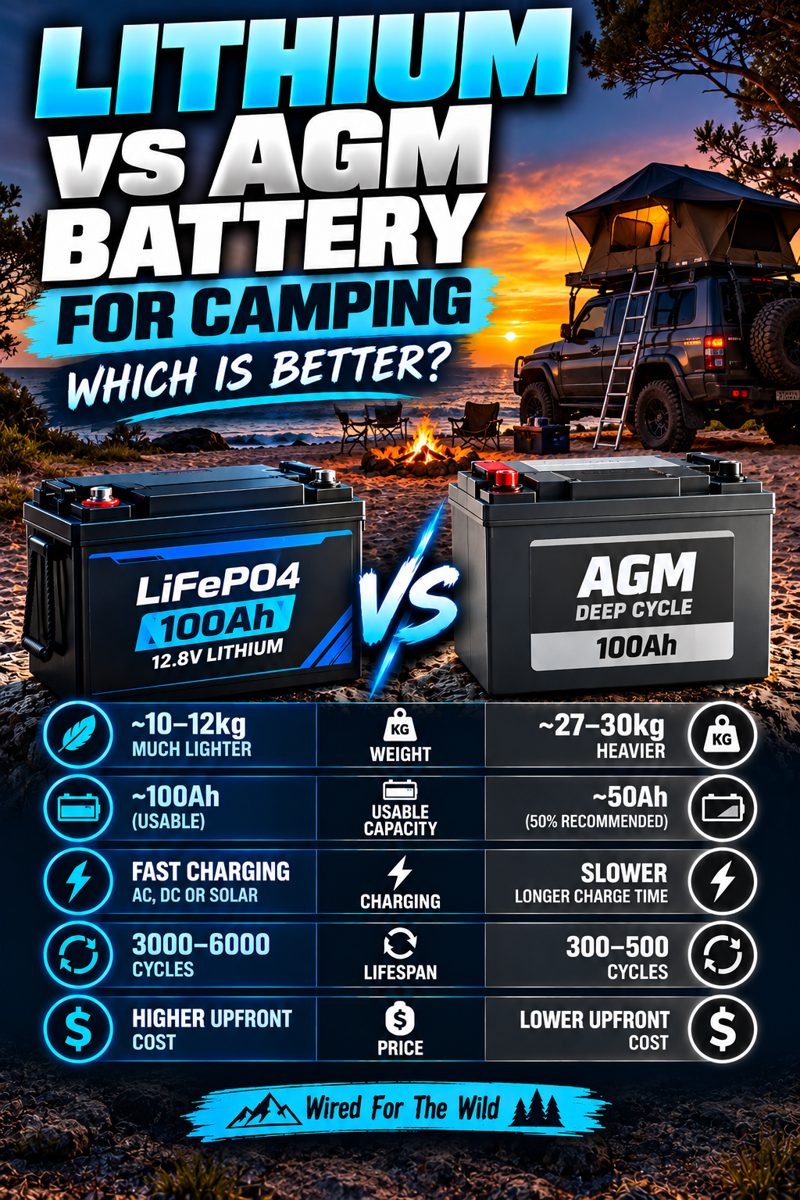
Comparing battery types? See Lithium vs AGM Battery for Camping.
Running a generator safely at camp
Carbon monoxide
- Only run a generator outdoors in a well-ventilated area.
- Never run it inside a caravan, tent, annexe, garage or any enclosed or partly enclosed space, even with ventilation. Opening doors and windows won't stop carbon monoxide building up inside.
- Keep it away from open windows, doors and vents, yours and your neighbours'. Point the exhaust away from vans, tents and anything that can burn.
- A battery-operated carbon monoxide alarm is a sensible extra precaution.
- If anyone feels sick, dizzy or weak near a running generator, get to fresh air straight away and seek medical help.
Weather
- Keep the generator dry and don't run it in rain or wet conditions unless its manual says it's suitable.
Refuelling and fuel
- Switch off the generator and anything connected to it, and let it cool before refuelling.
- Refuel on firm, level ground in a well-ventilated spot, and don't spill fuel. A hot engine or exhaust can ignite it.
- No smoking or naked flames nearby, and keep a suitable fire extinguisher handy.
- Store petrol only in containers made for fuel that comply with AS 2906, out of the sun, in a ventilated spot away from heat and ignition sources.
Electrical
- Look for the Regulatory Compliance Mark (RCM) on the generator.
- Use heavy-duty leads in good condition, and protect connections from the weather.
- Never back-feed a building or installation through a power point or switchboard.
- Any work on 240V wiring, including caravan mains inlets, generator inlets and changeover switches, must be done by a licensed electrician.
- Read your generator manual before using its earth (ground) terminal, and get advice from a licensed electrician if you're unsure.
- Follow the instructions from your generator, charger and battery makers.
For more on 240V safety, see the safety section of our 12V system guide.
Common mistakes and troubleshooting
- Running the generator in an annexe, under an awning or near the door. Keep it outdoors and well away from openings.
- The charger set to the wrong battery type. Match it to your lithium or AGM battery.
- A generator that's too small. Remember the charger draws more than it delivers, plus anything else that's running.
- Eco mode struggling under load. Check your generator manual.
- Using the generator's 12V outlet instead of a charger. It isn't a substitute for a proper battery charger.
- Long or thin leads and poor connections. These stop the charger reaching full voltage.
Battery not charging? Check these in order:
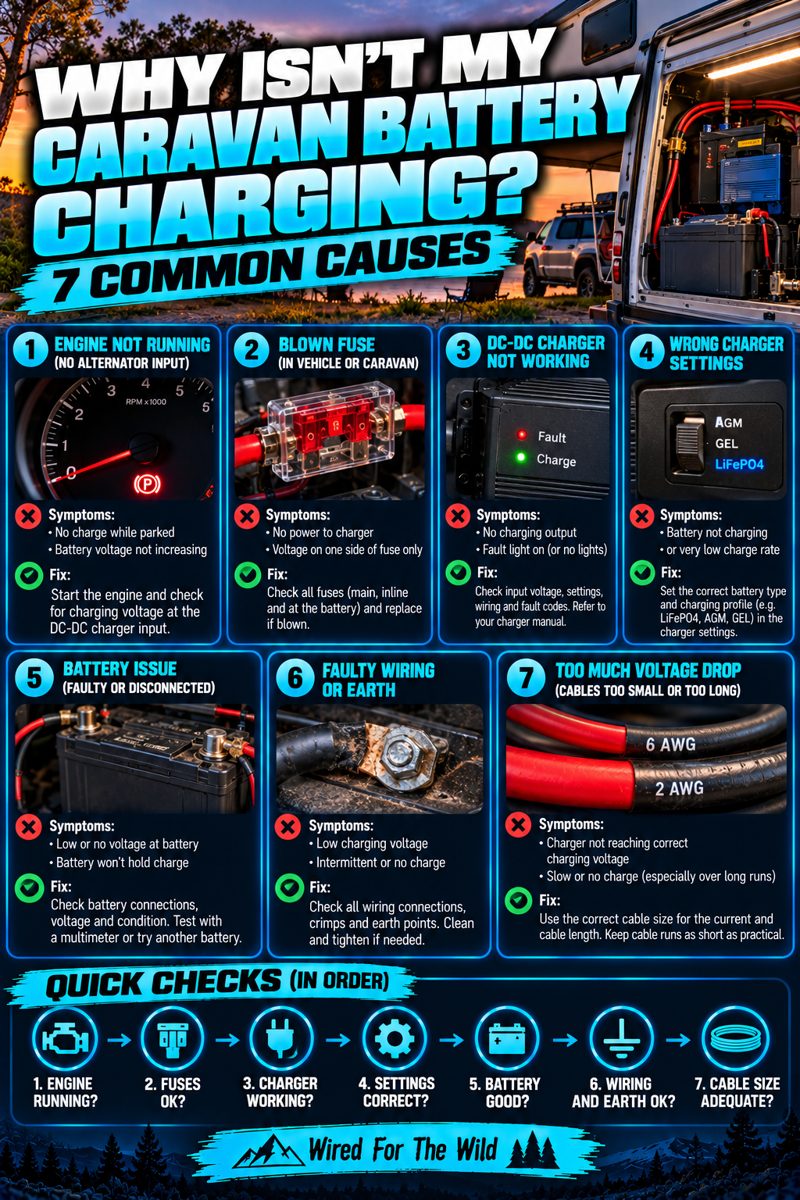
- Is the generator running and the charger switched on? Check there's power at the charger's input.
- Has the generator's overload protection or circuit breaker tripped? Check its manual.
- Is the charger showing a fault or error code? Check its manual.
- Is the battery type setting correct?
- Is a lithium battery too cold to charge?
- Are the battery terminals and connections tight and clean?
Still stuck? Our Why Isn't My Caravan Battery Charging? guide covers seven common causes.
Quick FAQ
Can I charge a lithium battery from a generator? Yes, through a 240V charger with a lithium (LiFePO4) profile set to your battery maker's voltages and limits. Don't charge it below its minimum temperature.
What size generator do I need for a 25A charger? It depends on the charger's efficiency and power factor. Use the figures from its label or manual and the method above, add anything else you'll run, and leave headroom. No single size suits every charger.
Can I use the 12V outlet on my generator to charge my battery? It isn't a substitute for a proper battery charger. These outlets are low-current, at least some are unregulated, and they don't have a lithium profile. Use a 240V charger instead.
Do I need an inverter generator? Not necessarily. Honda says inverter generators give cleaner, more stable power with lower harmonic distortion, which suits electronics, and many campers choose one. Check that the generator's output is within your charger's input range and follow the charger maker's advice. Victron's IP22 chargers, for example, accept 180 to 265V at 45 to 65Hz.
Gear picks
As an Amazon Associate I earn from qualifying purchases. Prices and availability are shown on Amazon.
Sources
Safety and technical points in this guide are based on these sources:
- Energy Safe Victoria: Using a generator safely
- Victorian Department of Health: Using alternative fuel and electricity generation safely
- NT WorkSafe: Carbon monoxide dangers of using portable generators
- SA Government: Using generators for back-up power
- SafeWork NSW: Generator refuelling incident
- Fire and Rescue NSW: Fuel storage safety
- WA Building and Energy: Camping safely with gas and electricity
- Victron Energy: Blue Smart IP22 Charger manual
- Victron Energy: MultiPlus Generator FAQ
- Victron Energy: Lithium NG battery manual
- REDARC: Why you should not charge a lithium battery below 0°C
- Honda: EU2200i owner's manual
- Honda Australia: EU22 specifications
- Honda: What is an inverter generator
- Yamaha Motor Australia: EF2200iS