The quick answer
An inverter turns your 12V battery power into 240V power, so you can run normal household appliances at camp. Choose a pure sine wave inverter, size it for everything you'll run at the same time plus start-up surge and some headroom, and make sure your battery, cable and fuse can handle the current it draws.
Any 240V wiring, such as connecting an inverter to a caravan's power points, must be done by a licensed electrician. Plugging an appliance straight into the inverter's own outlet is the simple, portable option.
What an inverter does
REDARC describes an inverter as a device that converts 12V DC battery power into 240V AC power. That lets you run things that only come with a 240V plug, such as laptop chargers, coffee machines and microwaves.
It's different from a battery charger, which works the other way and charges the battery from 240V. An inverter/charger does both. See the components section of our 12V system guide.
Pure sine or modified sine?
- Pure sine wave inverters produce smooth power like mains. REDARC says they suit sensitive electronics such as laptops, coffee machines and microwaves, and recommends choosing pure sine wave output.
- Modified sine wave inverters are cheaper, but REDARC warns that their rough output can damage or shorten the life of sensitive electronics.
For camping, where you'll often charge phones, laptops and camera batteries, pure sine is the safer choice.
What size inverter do you need?
- Add up the watts of everything you'll run at the same time. Use the rating on each appliance's label.
- Allow for start-up surge. Fridges, compressors and power tools draw extra power for a moment as they start. Check that the inverter's surge (peak) rating covers it.
- Add headroom. REDARC suggests sizing at least 20 to 50% above your calculated load. For a 1000W microwave, for example, it suggests a 1500W or 2000W inverter rather than a 1000W one.
Our Charger & Inverter Sizing Calculator does this for you. List your appliances and it estimates the continuous and surge rating you need.
Bigger isn't free. REDARC notes that larger inverters tend to have a higher standby draw, so they use more power when left on with nothing running. Choose what you need, and switch it off when you're not using it.
What it takes from your battery
An inverter can draw a lot of current from a 12V battery. As a rough guide, the current is about the watts divided by the battery voltage, plus the inverter's own losses. A 300W load is about 25A from a 12V battery before losses, and a 1000W load is over 80A.
- Size your battery to suit. REDARC says an inverter is only as good as the battery behind it, and that larger inverters (2000W or more) need around 200Ah of battery. Check your battery's maximum discharge current too.
- Work out your daily use. Add inverter appliances to our Battery Size Calculator to see how much of your battery they'll use.
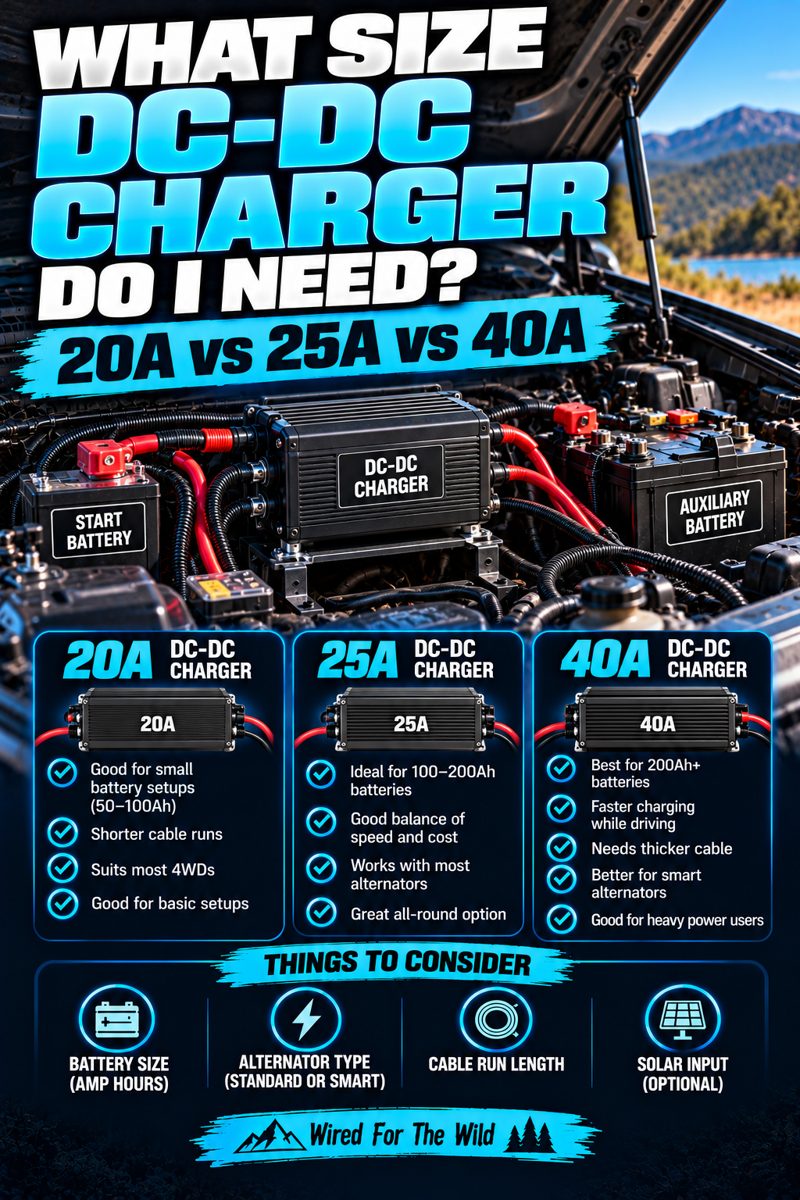
- Keep charging up. If the inverter runs from an auxiliary battery in your vehicle, a DC-DC charger keeps it topped up while you drive.
- Low-battery shutdown. Most inverters switch off when battery voltage gets too low. Check the setting in your inverter's manual and make sure it suits your battery type.
Cable, fuse and installation
Because of the high current, the cable and fuse between the battery and inverter matter a lot.
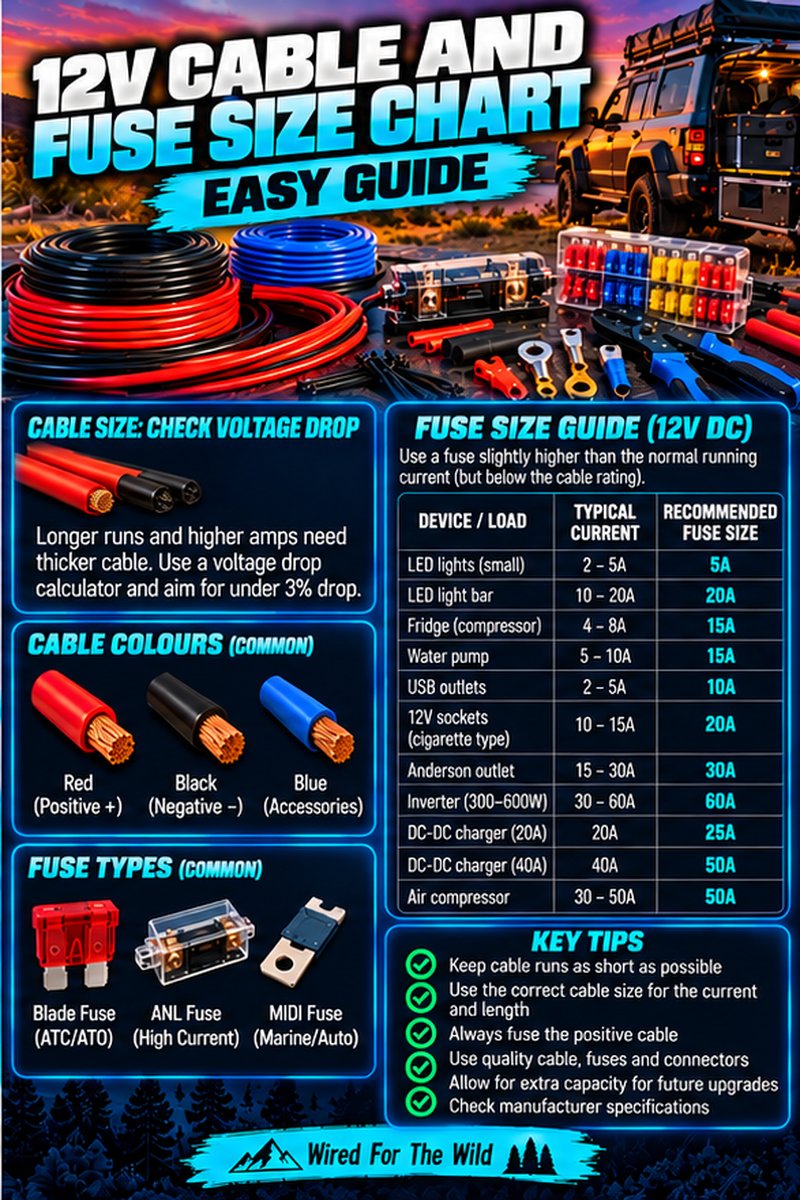
- Use the cable size and fuse rating in your inverter's manual. Victron's Phoenix inverter manual, for example, gives a specific cable size and fuse for each model, with the fuse on the positive cable.
- Keep the battery cables short. The same manual says to keep them as short as practical.
- Size the fuse and cable for the inverter's full rated current, not just the load you plan to run, and fit the fuse close to the battery. Our 12V Cable and Fuse Size Guide explains the method.
- Give it air. Victron says not to enclose the inverter, to keep its vents clear, and not to install it in battery compartments, fuel storage areas or engine compartments. Keep it dry and away from dust.
- Follow the manufacturer's earthing instructions. They vary between models.
- REDARC recommends its products are installed by a qualified auto electrician or technician.
240V safety
- Plug-in use: plugging an appliance directly into the inverter's outlet is the simple, portable option. Use appliances and leads in good condition, and follow the inverter maker's instructions.
- Fixed 240V wiring needs a licensed electrician. REDARC's AC wiring guide says AC mains wiring from an inverter must be installed by a licensed electrician in accordance with Australian wiring rules, and that a fixed installation needs an approved RCBO. Choosing between shore power and the inverter needs a mains changeover switch.
- Never connect the inverter's output to mains power or another AC source. Victron's manual warns against connecting the output to an incoming AC source.
- Get it checked. WorkSafe ACT recommends that 240V installations in caravans, camper trailers and motor homes are installed by a licensed electrician, certified as electrically safe and regularly inspected and tested.
For more, see the safety section of our 12V system guide.
Common mistakes
- Buying a modified sine inverter to charge laptops and other sensitive electronics.
- Forgetting start-up surge, so the inverter trips when the fridge or a power tool starts.
- Choosing an inverter too big for the battery, which flattens it quickly or trips the battery's protection.
- Thin or long battery cables, or a fuse that doesn't match the manual.
- Mounting it in a sealed box, an engine bay or beside the battery where it can't stay cool.
- DIY wiring into caravan power points. That's licensed electrician work.
- Leaving it switched on when nothing is running.
Quick FAQ
What size inverter do I need to run a microwave? More than the microwave's rating. REDARC suggests a 1500W or 2000W inverter for a 1000W microwave. Check the microwave's input power on its label, because it's often higher than the cooking power, and make sure your battery can supply the current.
Can I run a fridge from an inverter? Yes, but a 12V fridge runs directly from the battery without the inverter's losses. If you use a 240V fridge, allow for its start-up surge.
Can I wire an inverter into my caravan's power points myself? No. Fixed 240V wiring must be done by a licensed electrician, with the right protection and a changeover switch if the van also has shore power.
Do I need an inverter at all? Not always. Many phones, laptops and lights can charge from 12V or USB, which avoids inverter losses. A portable power station has an inverter built in.
Next steps
- Size it: Charger & Inverter Sizing Calculator.
- Check your battery: Battery Size Calculator.
- Get the cable and fuse right: 12V Cable and Fuse Size Guide.
- Already have a system? Check My System.
- See all the wiring and charging topics on the Distribution page.
Sources
Facts in this guide are based on these sources. Manufacturer figures are examples for their own products.