Battery Isolator Switches: Where They Go and Why You Want One
One switch that cuts the battery off completely. Handy for storage, safety and finding faults.
A battery isolator (or master) switch breaks the main positive cable so nothing can draw from the battery. Don't confuse it with a voltage-sensitive relay or DC-DC charger, which are also sometimes called "isolators".
1. Why fit one
- Storage: small loads like radios, USB sockets and monitors can flatten a battery over weeks.
- Working on wiring: you can make the system dead before you touch it.
- Fault finding: switching off tells you quickly whether a drain is real.
2. Where it goes
On the main positive cable, close to the battery and after the main fuse, in a spot you can reach easily. Mount it on a solid surface away from water.
3. Sizing
Choose a switch with a continuous rating above the highest current the system draws, including an inverter at full load. Also check its short-term (surge) rating if you run a big inverter.
4. What stays connected
Some things should stay on even in storage, such as a battery monitor or a solar controller feeding the battery. Check the maker's instructions: some solar controllers must not be left connected to panels with the battery disconnected.
5. Common mistakes
- Undersized switch that gets hot under inverter load.
- Mounted somewhere you can't reach in the dark.
- Switching off the battery while the solar controller is still connected to the panels, against the controller's instructions.
6. Quick summary
- A master switch cuts all loads, which is great for storage and safety.
- Fit it on the main positive near the battery, rated above your biggest load.
- Check your solar controller's instructions before you isolate the battery.
Work on 240V AC wiring, including inverter outputs and mains inlets, must be done by a licensed electrician. For high-current DC gear, follow the maker's installation manual and have an auto electrician check your work if you're unsure.
Related guides
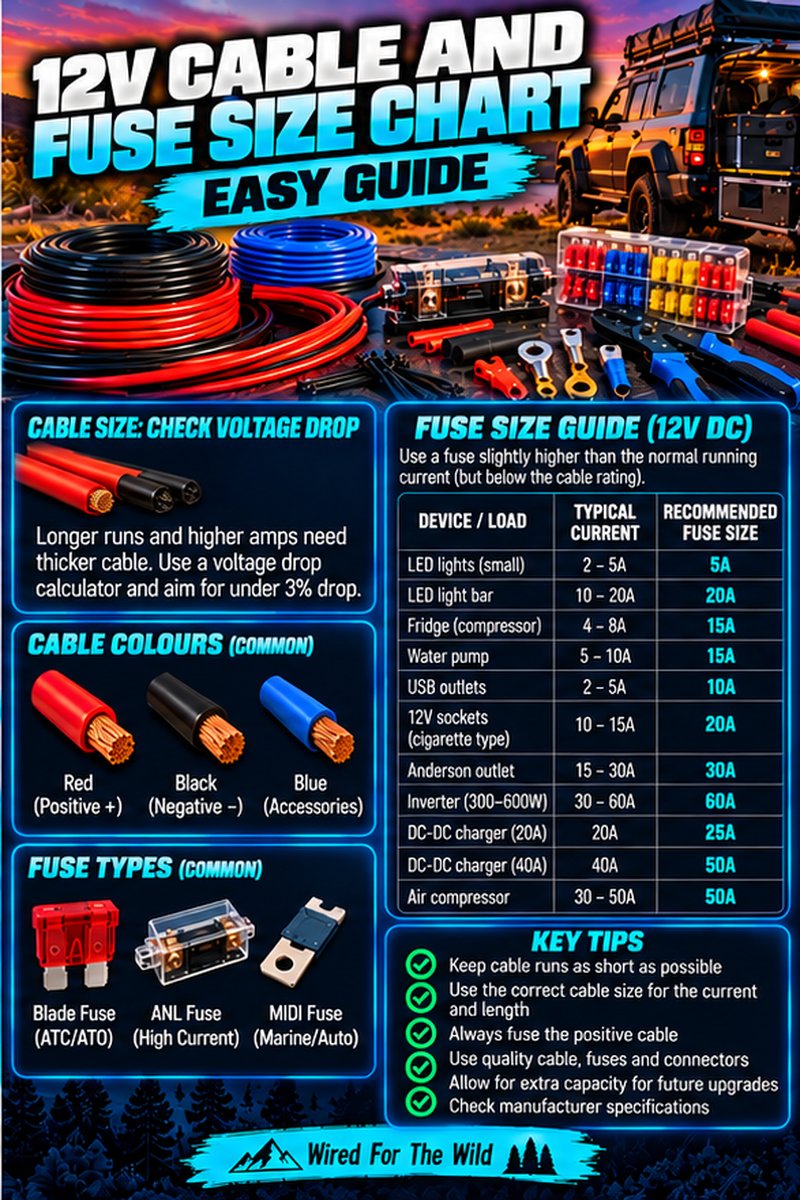
12V Cable and Fuse Size Guide
A simple step-by-step method for choosing 12V cable and fuse sizes, with a worked light bar example, common fuse types and mistakes to avoid.
Read guide →How to Read a 12V Battery Monitor
What the numbers on a 12V battery monitor mean: volts, amps, watts, state of charge, amp-hours used and time remaining, and how to keep it accurate.
Read guide →