12V LED Camp Lighting: What Draws the Least Power
LED lighting is the cheapest power at camp. Here is how to work out what it costs your battery.
LED lights use a small fraction of what old halogen globes did, so lighting is rarely what flattens a battery. Rarely, but not never: a long strip left on all night adds up.
1. Read the label
Most LED lights are rated in watts. On a 12V system, amps ≈ watts ÷ 12. A 6W light draws about 0.5A.
2. Work out a night
Watts × hours = watt-hours. Two 6W lights for 4 hours: 2 × 6 × 4 = 48Wh, or about 4Ah from a 12V battery. That's small next to a fridge, which can use 300Wh or more a day.
3. Strips and bars
LED strips are rated per metre. A 5m strip at 4.8W/m draws about 24W, around 2A. Fine for a few hours, but it's the light most often left on.
4. Ways to save
- Use warm, dimmer lights inside and save the bright bar for jobs.
- Fit a dimmer or a switch at the door.
- Use motion-sensor lights for the toilet path.
- Turn off decorative strips when you go to bed.
5. Wiring
LED lights draw little current, but the cable still needs a fuse at the supply end sized for that cable. Long thin runs can still drop voltage, which can make cheap LEDs flicker.
6. Quick summary
- Watts × hours = Wh. LEDs are cheap to run.
- Watch long strips left on all night.
- Fuse every circuit for its cable.
Work on 240V AC wiring, including inverter outputs and mains inlets, must be done by a licensed electrician. For high-current DC gear, follow the maker's installation manual and have an auto electrician check your work if you're unsure.
Related guides
How to Calculate Your 12V Power Needs for Camping
Work out how much 12V power you use in a day at camp: watts, hours, fridges that cycle, inverter losses and a margin, with a worked weekend example.
Read guide →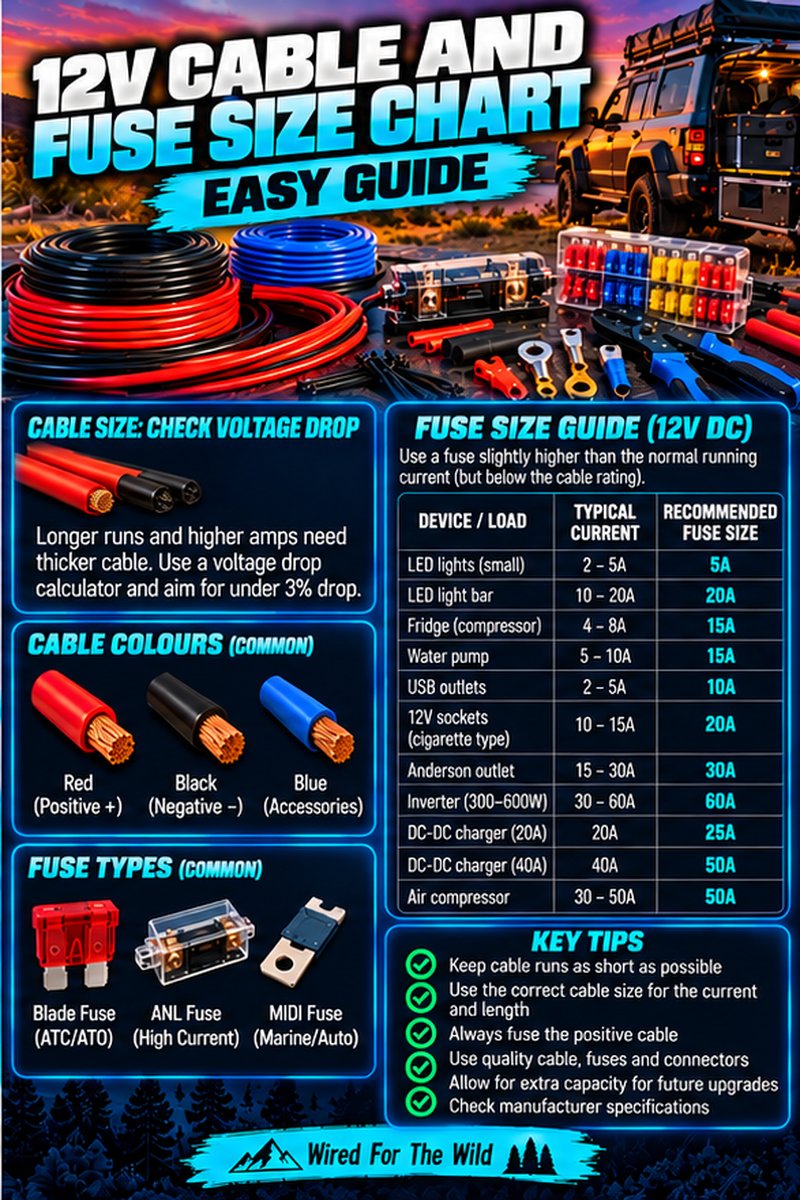
12V Cable and Fuse Size Guide
A simple step-by-step method for choosing 12V cable and fuse sizes, with a worked light bar example, common fuse types and mistakes to avoid.
Read guide →